

The iconic toy company, Mattel, unveiled its first ever Autistic Barbie this month, and while she’s divided parts of the autism community over what representation should look like, in doing so, she’s shown us how far representation can expand in an increasingly neurodivergent world.
“Growing up, I never saw anything that looked remotely like myself in a doll,” Love on the Spectrum star Dani Bowman said in a TikTok video. “Autistic characters were either stereotypes or not there at all. So when I saw the new Autistic Barbie, I immediately went online and I saw the concerns from autistic self advocates. And you know what? I agree with them.”
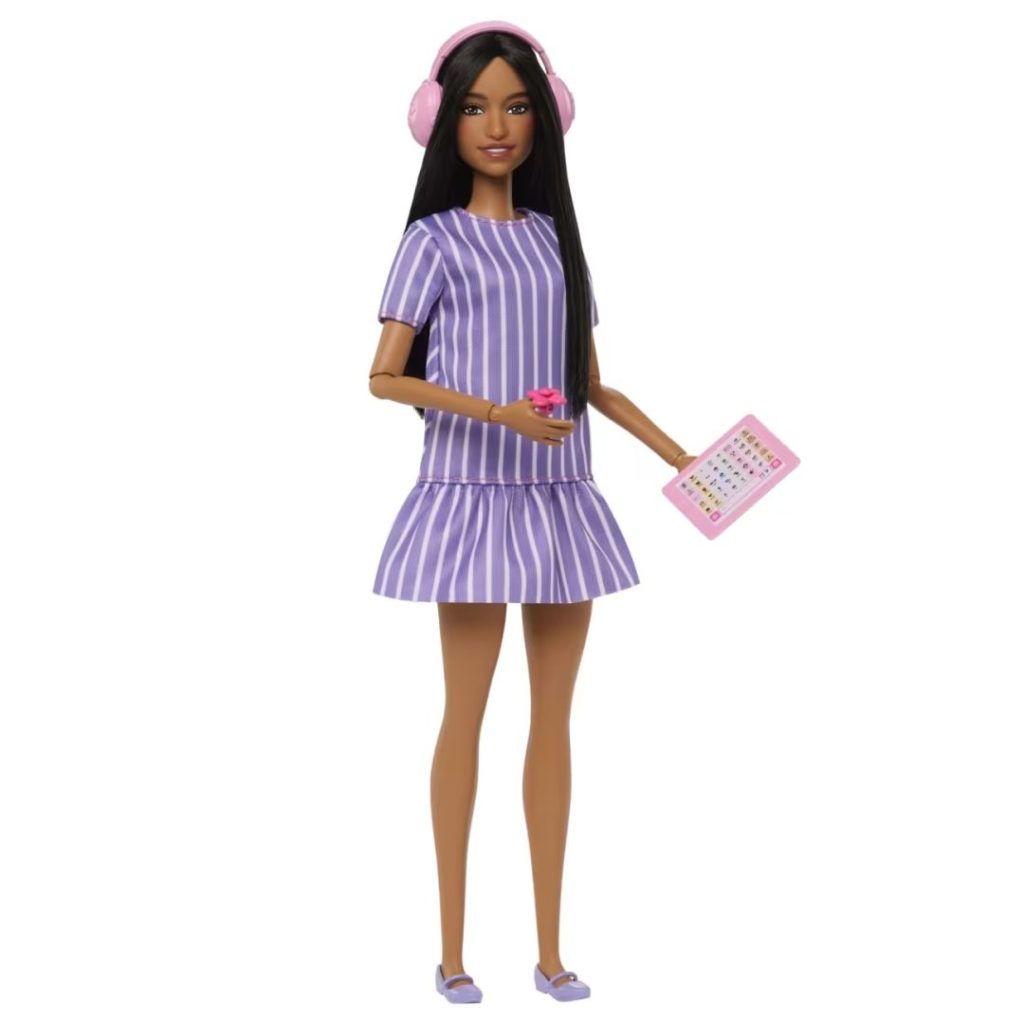
In the interest of representing the world’s growing population of neurodivergent minds, Mattel partnered with the Autistic Self Advocacy Network (ASAN), to represent some common ways autistic people may express themselves, process stimuli and communicate with the world around them. Thus, Autistic Barbie was born; complete with her own set of noise cancelling headphones, fidget spinner, and communication device (all Barbie-pink, of course). To neurotypicals, she might not seem like much more than an adorable doll dressed in a purple dress, but to the neurodivergent community, she’s different things at once: the missing piece of their toybox and a girl that’s supposed to be like them, but isn’t.
After all, representation means more than simply seeing yourself in Barbie’s Dream House. It’s knowing that the world acknowledges your existence, and values it just as much as the white, tall, thin, blonde, neurotypical existence — the kind that goes to space, runs for president and still manages to keep her hunk-of-a-boyfriend comfortably unthreatened. With that said, it’s important to represent right.
Representation means more than simply seeing yourself in Barbie’s Dream House.
“Autism isn’t an accessory” one mother of an autistic child commented on Mattel’s post, writing, “It is not defined by headphones, toys, or visual cues. When autism is reduced to simplified, stereotypical elements, it doesn’t educate. It misleads and risks turning a complex reality into something symbolic and comfortable instead of truthful.” Her point wasn’t about rejecting inclusion. It was, as she put it, “about asking for it to be done with respect, accuracy and responsibility.”
Which made me think: How could one possibly represent an entire spectrum of people in a single doll? Autistic people might have one pattern of behavior, or another, or a mix of multiple. Besides, autism rarely exists in isolation and is often accompanied by ADHD, learning disabilities, Tourette Syndrome, or something else entirely.
“This Barbie doesn’t represent the entire spectrum,” Bowman said. “For example, I don’t use any alternative communication devices, I don’t have sensory clothing needs and my stimming looks different. But that’s not the point. Autism is incredibly diverse. No single doll can capture the whole story.”
How could one possibly represent an entire spectrum of people in a single doll?
But maybe that’s the throughline — no single doll can be what all autistic people are. After all, about 15 to 20 percent of the world’s population is thought to be neurodivergent in some way. So maybe, in the spirit of — not inclusivity, but reality — Autistic Barbie is really just “sensory regulation and communication aid Barbie”; the first in a long line of neurodivergent dolls that a child somewhere can see themselves in, even if just for a moment.
“For the first time ever, a major brand worked with Autistic Self Advocacy Network and said, ‘Let’s make a doll that reflects some real autistic experiences in a positive way.’ And even if it’s not my experience,” Bowman said. “It is someone’s, with autism, and that visibility can be life-changing.”
Representation doesn’t have to be perfect to be meaningful. Sometimes, it just has to be present — long enough for a child to play.





Your email address will not be published. Required fields are marked with *