BY TED MCCARTHY
Often it feels as though I’m navigating a stuttering, strobing world. This can intensify, the stop-gap animation joined by a brass and drum ensemble — all of it sending buzzing, thrumming signals pounding through my cortex. In these times, I must beg my brain to shut up, and my loud and stubborn body too.
And sometimes, while running, I succeed.
There are about as many expressions of Tourette’s as there are Tourettic individuals. For me, the condition consists of a proliferation of twitches: always physical, frequently forceful, sometimes painful. These tics are brought on by a “premonitory urge,” an itch-like impulse that compels us to blink, or speak, or thrash. Though just as anyone can, in theory, choose not to scratch an itch, the effort is taxing — and it can become all-consuming when the itch appears every few seconds, every waking hour.
As is the case for many neurodiverse individuals, Tourette’s presents my daily life with 2 distinct obstacles. The first is what my mind does when I’m alone — the exhaustion, distraction, and pain my tics cause me, a lifelong familiarity with soreness, stiffness, and even unintended self-harm. And then there’s the world’s reaction to these behaviors — the anxiety, embarrassment, and overwhelm — a secondary impact of the tics, but no less frustrating.
Peter J. Hollenbeck, former co-chair of the TSA Scientific Advisory Board, describes Tourette’s as “a disease of the onlooker.” If I tic alone in the woods, no one’s there to mock me — but we are social creatures, and experience our thrashing, cyclonic bodies in the judgmental eyes of the world. Hollenbeck’s words bring to mind the man who punched me when he thought I’d winked at his girlfriend, the cop who reached for his gun at a routine traffic stop, the many museum security guards who’ve shadowed me from room to art-filled room. Of the countless times I’ve been obliged to tell a stranger that I’m okay — not sore nor stiff nor dancing, about to vomit, have a panic attack, or have a seizure. That I’m not at this very moment high on, nor interested in purchasing, cocaine.
All of this is, of course, frustrating. But a growing body of research, as well as decades of lived experience among neurodiverse individuals, points to how exercise and other forms of deep, immersed focus can help quiet our bodies and minds.
A growing body of research, as well as decades of lived experience among neurodiverse individuals, points to how exercise and other forms of deep, immersed focus can help quiet our bodies and minds.
It’s long been understood in the Tourette’s community that deep focus can improve tic symptoms in the short term. This is especially true of the skilled, enjoyable “flow” sort of focus described by late psychologist Mihaly Csikszentmihalyi, when time seems to disappear as one becomes fully engrossed in some pursuit. I rarely tic when I’m writing, playing piano, or having sex. Danny Stofleth, a friend with Tourette’s, told me how meditation takes him “out of the present” where “tics aren’t a part of it,” and how playing basketball forces him to constantly focus on the ball and his movements around the court. I have begun to ski in very challenging and often dangerous terrain, and I understand that the total focus this demands holds much of its allure. If I tic while playing piano, I may miss a beat; but if I do so perched atop a rocky cliff, I could get very badly hurt, or worse. And so I cease to tic.
Recent studies have affirmed that exercise can help reduce anxiety, ADHD, and Tourette symptoms, and even provide Tourettic individuals greater regulation of their symptoms once a workout ends. I’ve experienced this myself, realizing as I push through a run’s blistering pain that I can surely use the same discipline to regulate my tics. Peter Yeomans, who discovered his neurodivergence as an adult, describes feeling a “horrible knotty screamy feeling… like the alien about to come out of me” during times of heightened anxiety and activation — and how “falling in love” with hot yoga helped him build resilience against this discomfort outside the studio.
Overcoming the knotty, screamy feeling is one thing; then there’s being rid of it altogether. It may be for this reason that running, for myself and other neurodiverse people with whom I spoke, holds a special ability to calm our rattling brains.
Dr. Hollenbeck has written about his own experience running and described to me the “incredible Zen feeling” he feels on tempo workouts. “I don’t think I’d have a single tic the whole hour, because that was my maximum flow state. Running…. and thinking about being relaxed, and thinking about being smooth and thinking about running.” Thinking, in other words, about anything but ticcing.
Masha Shukovich, who was diagnosed with neurodiverse traits as an adult, described to me how running gets her “out of her own overwhelm or confusion,” the “radical simplification” running induces in her, when she must only focus on her movements and her breath. And Dr. Samuel Zinner, another Tourette’s researcher, described to me a feeling he recently experienced on a run: “I noticed that I had no interest to tic.” He knew this was funny phrasing, but I understood him well. Exercise, he says, can deliver “freedom, in some ways, from my body. Or at least transplantation to another body that is not my body.”
Exercise, he says, can deliver “freedom, in some ways, from my body. Or at least transplantation to another body that is not my body.”
Goosebumps rise on my skin when I read his words, because I cannot think of a desire I have felt at times more fiercely than this. And I have occasionally experienced it.
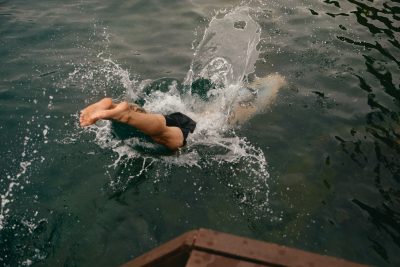
One winter night years ago, I was running laps around the East River Park track. It was cold — too cold, the “wintry mix” that frequently afflicts the Northeast United States — and I was moving as fast as I could. Coursing toward the river and then alongside it, enveloped in the night sky and the lights and the river reflecting the lights, I suddenly felt serene. Afloat. Or if not afloat then underwater, when you take a deep breath and descend, and it’s just your heartbeat and watery thrum and nothing else, not even your lungs. What more is a womb?
I knew the world would once more stutter and strobe, that this would attract and repel countless strangers until I’d sometimes want to scream — but in that brief moment, I felt peace and power. I felt free.
I knew this feeling would soon vanish, but in that brief moment, I felt peace, and power — and free.
BIO: Ted is a writer and researcher who gravitates toward city living but misses nature whenever he’s there. He publishes a newsletter and podcast exploring how the internet is changing culture and politics around the world, and is slowly writing a book on the same.