Every season of Euphoria sparks endless online discourse about sex, drugs, trauma and spectacle. But one of the most foundational elements of Rue Bennett’s (Zendaya) character remains structurally overlooked: her neurodivergence.
Long before Rue became television’s most infamous teenage addict, she was a child diagnosed with ADHD and OCD — a dopamine-seeking, emotionally dysregulated girl whose mind was treated as a problem to medicate before it was ever fully understood.
“I don’t remember much between the ages of 8 and 12,” Rue confessed in the pilot episode. “Just that the world moved fast and my brain moved slow.”
To understand where she is in season 3, we must revisit her origin-story, which was consequential enough to be the series’ opening sequence: three days after the attacks on the Twin Towers, Rue was born.
“And then, without warning,” she narrated. “A middle-class childhood in the American suburbs.”
Long before Rue became television’s most infamous teenage addict, she was a child diagnosed with ADHD and OCD.
The Diagnoses
Void of any abuse or neglect, her family worried about her inability to concentrate, her persistent anxiety attacks, her being a bit… different.
In the opening scene, Rue is young — maybe 5, but no older than 7 — sitting at the dining table with her mother and audibly counting the panels on the ceiling-light above them. She made it to fifteen, before her mother’s repetitive and singular line of questioning — “What are you doing?” — interrupted her. Young Rue pauses, glances at her, and returns to the ceiling, starting over again: “One, two, three…”
“What are you doing?” Her mother asks again. “Rue?”
This time, she pulled Rue’s focus entirely, triggering tears — audible tears — before the scene cuts to a psychiatric office where a doctor describes her as “suffering from obsessive compulsive disorder, attention deficit disorder, general anxiety disorder, and possibly bipolar disorder,” adding, “but she’s a little young to tell.”
It was then her mother’s turn to sob.

Growing Up Neurodivergent
A few years later, Rue was about 10 years old — not quite a teenager but becoming capable of understanding that she was different from the other kids in her class.
Her mother, softened by a smile, was packing a pill-organizer labeled with the days of the week when she explained, “Honey, it’s just the way your brain is hardwired. Plenty of great, intelligent, funny, interesting, and creative people have struggled with the same things you struggle with.”
As she named some famously neurodivergent icons, the screen cut to their famously dark moments: Vincent Van Gogh, who’s believed to have died by suicide, Silvia Plath, who was found dead with her head in her oven, and finally, Britney Spears, memorialized by the infamous scene of her in a stretcher after she shaved her own head in a hair salon — each one a cultural juggernaut defined by their brilliant contributions to the world, but often remembered for moments when the pressure finally became too much to bear.
It goes without saying that we are not destined for a Greek tragedy-level fatal flaw. But this editorial choice was certainly a choice — foreshadowing the slow-motion catastrophe that might have been solved had Rue sought harmony with her mind, as opposed to a chronic conflict with it. But a hospital visit for an anxiety attack intensified 11-year-old Rue’s internal conflict, becoming the catalyst for a life of self-medicating.
When We Don’t Have Support…
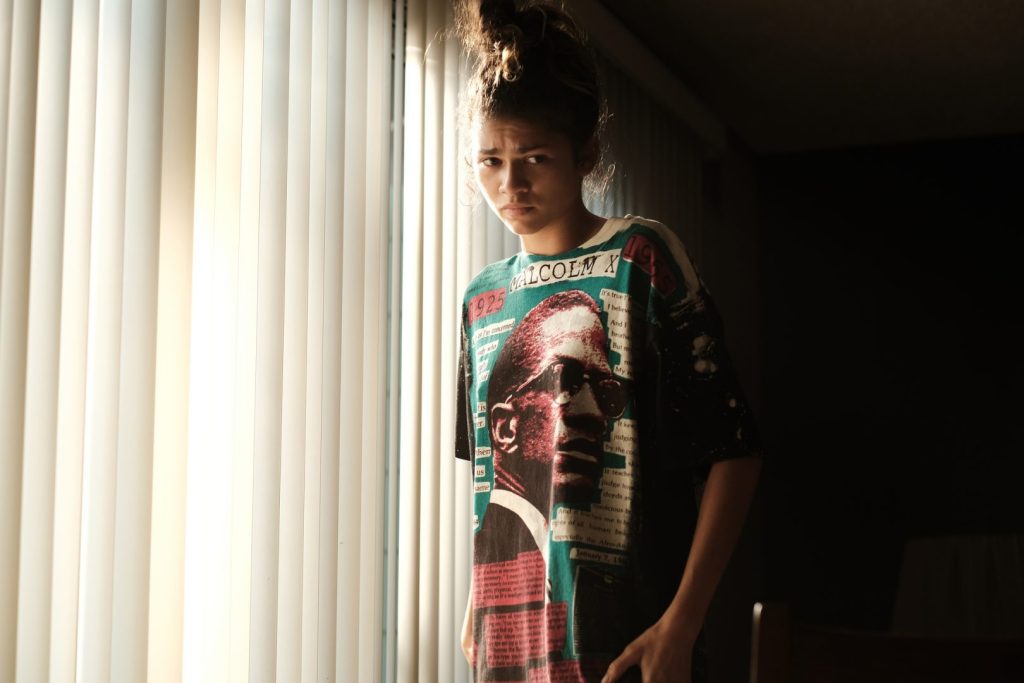
“They gave me liquid valium to calm me down,” she said. “This is the feeling I’ve been searching for my entire life, for as long as I could remember. Because suddenly, the world went quiet and I felt safe in my own head.”
OCD, which Rue has and is increasingly considered a form of neurodivergence, is commonly found concurrent with addiction as a result of impulsivity. The same can be true with ADHD, which Rue also has. Both ADHD and OCD are dopamine-seeking — making different substances feel like a solution. But by the time their short-term nature reveals itself, dependency has often already formed.
That’s yet another reason why support can be so validating, and even life-saving for us. Since, with the neurotypical pressures of the world as it’s currently designed, life can feel impossible and sometimes desperate.
As Rue put it, she “never felt like she was, like, good at life.”
Ordinary neurodivergent childhood behaviors — meltdowns, obsessive counting, and sensory sensitivities — were quickly framed as symptoms to suppress and fix rather than experiences to understand.
And like the doctor said all those years ago, she was young… possibly too young to tell. Yet ordinary neurodivergent childhood behaviors — meltdowns, obsessive counting, and sensory sensitivities — were quickly framed as symptoms to suppress and fix rather than experiences to understand. Instead of being given the space to discover who she was and how her mind functioned, Rue was taught early that her brain was something to fight, manage, and medicate.
Euphoria ultimately becomes a cautionary tale about what can happen when understanding comes second to correction — when a child learns to see herself as a problem before she has a chance to understand herself as a person.
While Rue is fictional, the fears surrounding her are real. They raise uncomfortable questions for parents, schools, doctors, and systems that too often rush to discipline, diagnose, or reshape children before listening to them.
Because Rue might have needed help. She certainly does now. But perhaps, before being taught how to suppress herself, she should have first been taught how to understand herself.