- 20% of the population has dyslexia
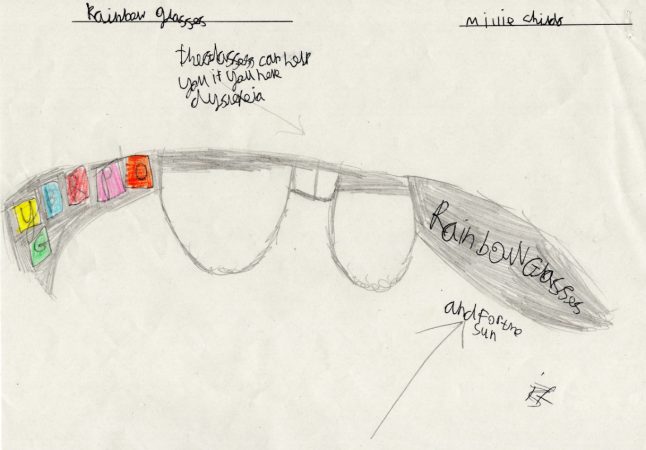
- A 7th grader in the UK drew “Rainbow Glasses” for a STEM competition asking students, “If you were an engineer, what would you do?”
- Out of 70,000 entires, her design stood out. Professional engineers designed a prototype of the glasses.
Who would ever think that a pair of glasses could alleviate the pain and challenges of dyslexia? Apparently, a 7th grade schoolgirl in the United Kingdom.
Eleven-year-old Millie Childs spent years suffering from headaches so severe that the seemingly simple act of reading would make her nauseous. And she isn’t alone — 20% of the population has dyslexia, experiencing similar challenges.
Her lifelong struggle with dyslexia was also the catalyst of what she calls “Rainbow Glasses”: an invention that’s drawn the attention of the National Health Service.
Once merely a girl’s big idea is now a working prototype that uses interchangeable, adjustable different-colored lenses, making reading easier and less overwhelming for others like her.
Once merely a girl’s big idea is now a working prototype that uses interchangeable, adjustable different-colored lenses, making reading easier and less overwhelming for others like her.
“Reading has always been a challenge for me,” Millie told her classmates at Light Oaks Junior School. “So I wanted to invent something that could make it easier. Seeing engineers turn my idea into real glasses has been incredible. I’m really proud to think they might one day help other people with dyslexia.”
It began when Millie entered a UK-wide STEM (Science, Technology, Engineering, Mathematics) competition that asks pupils between the ages of 3 to 19, “If you were an engineer, what would you do?” In her answer, Millie drew from her personal experience, conceptualizing a product that stood out in a sea of over 70,000 entries — enough to be selected by professional engineers who then spent 7 months building it into a working prototype.
“It’s something a lot of people have not thought of before and it’s a real-world problem,” Benjamin Butcher, a graduate mechanical engineer who worked on the prototype said. “It’s been able to address something that’s so common with people that people just tend to overlook it a little bit.”
But those involved in the project aren’t the only ones who seem to agree. Last December, Millie was recognized with the Gold Award in the Primary Engineer MacRobert Medal, the sister achievement to the UK’s most prestigious engineering prize, the MacRobert Award. Millie’s former teacher who collected the award on her behalf, Rob Entwistle, said that the idea stood out the moment she presented it, wanting to create a solution for others who faced the same challenges as her. “Watching her idea grow from a drawing into a working prototype has been inspiring,” he said.
Of course, not all dyslexia is the same. But many people experience visual stress when they read, which feels like letters moving, blurring or doubling and a visual experience often described as words seemingly “swimming” around the page. Black text on a white page or whiteboards found in classroom settings, can create “visual noise,” leading to glare or headaches and causing disruptions in a student’s ability to read efficiently. But Millie realized that adding a colored tint can reduce glare, soften contrast and, in turn, help the brain lock onto text more steadily.
One person might read best with blue while another could prefer yellow or green, which is why customizable rainbow lenses are important — letting the user find the setting that calms and stabilizes their brain the most.
Millie’s invention could certainly help a subset of people who experience visual stress, changing the visual environment so their brain doesn’t have to work as hard to stabilize writing.
Of course this doesn’t fix dyslexia. But like neurodiversity across the board, neurodivergent brains often need accommodations, and Millie’s invention could certainly help a subset of people who experience visual stress, changing the visual environment so their brain doesn’t have to work as hard to stabilize writing.
And, according to Harry Topping, a manufacturing apprentice on the prototeam, the next step is to acquire the funding necessary to get the product on the shelves, and thereafter, on the faces of dyslexic people everywhere.
“Over seven months we researched, planned, built and tested the design to create a prototype that met her expectations,” Sam Hassan, a Bid and Programme Management Graduate said of the project. “Our journey included weekly meetings, input from researchers at the University of Georgia, delivering STEM lessons in Millie’s school and a visit from Millie and her friends to see the final prototype.”
We as neurodivergent people have a long history of life-changing innovation — and a child identifying her exact friction point, and designing a tool that adapts the world to her brain, is just another notch on that timeline.
“I think it’s going to change people’s lives if I’m honest,” Millie’s mother, Sarah, told BBC. “A lot for the better.”
But ultimately, Millie’s brilliance doesn’t stop at inventing a pair of glasses. It begins with her unique awareness of the fact that it isn’t people that need fixing — it’s their environment that needs adjusting.