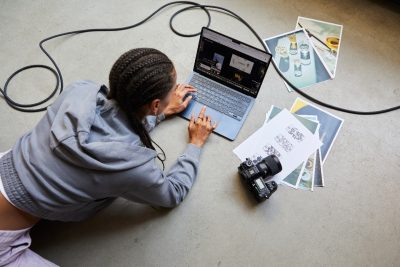
For decades, schools and workplaces punished many of the same traits now being repackaged as an advantage in AI: nonlinear thinking, deep focus, obsessive curiosity, unusual pattern recognition, and resistance to conventional processes and arbitrary rules.
Hence, the race to AI discovered its secret weapon, hidden in plain sight: neurodiversity.
A few months ago, a video of Alex Carp, the CEO of one of the most competitive companies at the intersection of AI and national security, went viral. He was giving an interview at the New York Times DealBook Summit and was unable to sit still — fidgeting, skittering, bouncing, eyes darting around the room. It quickly prompted “drug-use” accusations. But by the next week, his company, Palantir, directly addressed the murmurs, through a standard statement accompanied by a new initiative:
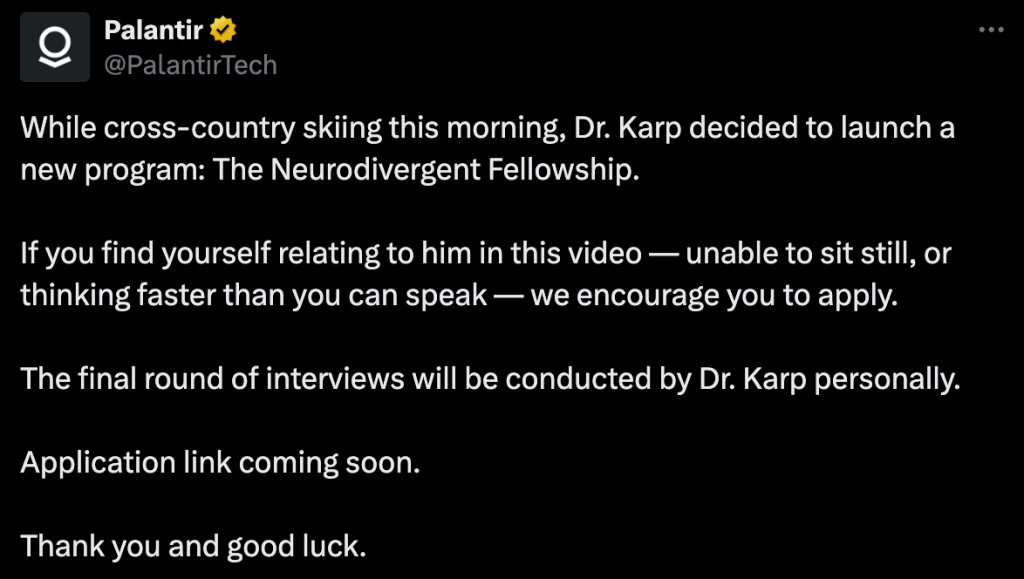
As companies scramble to build, govern, and commercialize this technology, neurodivergent cognition is being widely reframed from a workplace liability to a strategic asset. Research and corporate case studies increasingly suggest that neurodivergent people may excel in roles involving pattern recognition, anomaly detection, debugging, data labeling, unconventional ideation, and ethical stress-testing.
Neurodivergent cognition is being widely reframed from a workplace liability to a strategic asset
“The neurally divergent (like myself) will disproportionately shape America’s future,” Dr. Karp said in a statement. “We see past performative ideologies and perceive beauty in the world that still exists — which technology and art can expose.”
It was only a matter of time until our neurodivergent brains were recognized for their many strengths… and less surprisingly, the catalyst was the demand for AI development and AI-enabled work.
After all, it’s a mutual benefit — with AI tools reducing traditional workplace barriers for us by drafting emails, organizing tasks, summarizing meetings, managing executive function load and helping with written communication and processing. And, in turn, we can contribute distinct strengths to the software itself through their keen pattern recognition, anomaly detection, sustained focus, high tolerance for repetition in data work, nonlinear problem-solving, sensitivity to logical inconsistency and ability to challenge default assumptions.
But Karp and Palantir aren’t alone — they’re just the latest. We’re seeing global companies integrating neurodivergent professionals into their AI development workflows, and as more adopt AI tools, the focus shifts from who can utilize the tech to who acquires the insight needed to teach it.
As Enabled Intelligence CEO Peter Krant wrote back in 2023, “[Neurodivergent] teams help detect objects others miss, including camouflaged missile launchers and unexploded ordinances in Ukrainian farm land, protecting Ukrainians from potential harm. Their neurodiversity is a ‘superpower’ as they assess millions of satellite images for that ‘needle in a haystack’ detection.”
Of course, we as neurodivergent people aren’t the only ones who can effectively do this work. But these unique traits raise a strong case for arguing that neurodiversity is uniquely positioned to both benefit and benefit from the world of LLMs.
Hiren Shukla, for instance, founded EY’s neurodiversity program, and has ADHD and dyslexia. And according to Shukla, as organizations increasingly recognize the value of neurodivergent talent, and as A.I. tools become more inclusive, and the impacts ripple across society.
“It’s not just AI helping neurodivergence,” he said. “It’s the power of neurodivergence maximizing the use of Copilot [Microsoft’s LLM]. When you harness that divergence and partner with AI, you’ll see greater innovation, higher use cases, more ideation and application of AI”
And it isn’t just anecdotal — a growing body of peer-reviewed and industry research is positioning neurodiversity as a strength in artificial intelligence.
One study by Temple University found that neurodivergent workers labeling images and text for AI often produced more varied and useful results, in turn helping AI systems become more accurate and less biased. The researchers also found autistic workers to be more consistent and logical in their labeling, and were less likely to get thrown off by changing context — something that’s especially important when training artificial intelligence. And a paper in the Journal of Computing and Communication Engineering cosigned the findings, with its authors emphasizing that this type of work, often dismissed as routine, is foundational to the accuracy of LLMs.
Even more, a 2025 EY Global Neuroinclusion at Work Study found neurodivergent employees to outperform their peers in roles that require pattern recognition, logical reasoning and sustained attention, its companion framework reported measurable productivity gains when similar employees were involved in similar tasks, and a Virginia AI company, Enabled Intelligence, noticed these findings in practice. In fact, more than half of its workforce identifies as neurodiverse.
A future with equitable, ethical and innovative technology cannot be built without neurodivergent minds.
And according to the blog post from its CEO, Peter Kant, that’s by design. Noting that a striking percentage of those on the spectrum are unemployed, he asked, “Why are we leaving these valuable workers on the sidelines?”
“We know that neurodiversity leads to less biased data and that neurodiverse individuals excel at bias identification and elimination,” he wrote. “We must therefore aggressively engage neurodiverse individuals in AI development and create workforces that support diversity of thinking.”
Since declarations like the 2022 Deloitte report, concluding that neurodivergent members are about 30% more productive in innovation-focused roles than those without, Palantir, along with SAP and Microsoft have launched neurodiversity hiring programs.
Because frankly, a future with equitable, ethical and innovative technology cannot be built without neurodivergent minds.